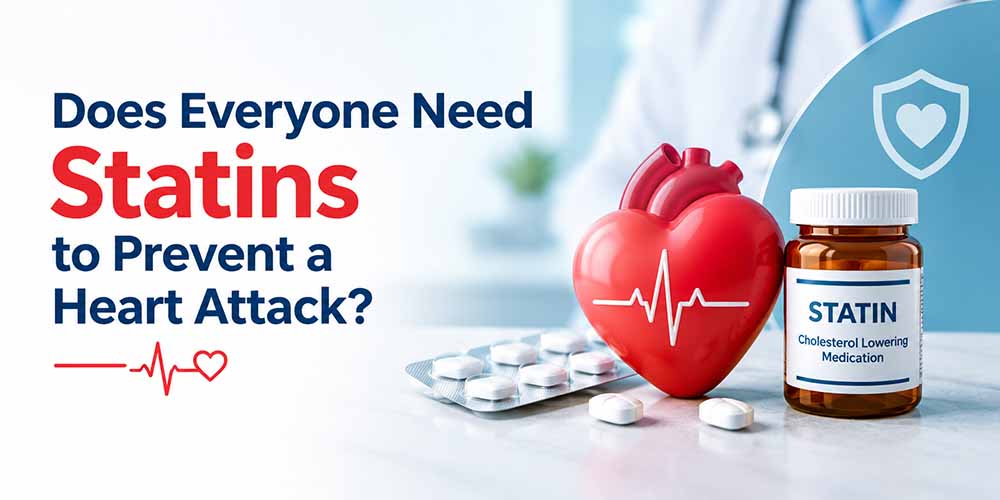
Does Everyone Need Statins to Prevent a Heart Attack
A compelling question: Should everyone take a statin?
Statins have transformed the prevention of heart attacks and strokes. Yet one question continues to generate considerable confusion:
“If statins prevent heart attacks, should everyone take one?”
The short answer is no.
But the opposite statement—“statins are unnecessary unless cholesterol is very high”—is also misleading. The modern approach is more nuanced.
A person's decision to take a statin should depend on overall cardiovascular risk, LDL cholesterol, other risk factors, evidence of atherosclerosis, and individual circumstances.
The latest 2026 American College of Cardiology/American Heart Association (ACC/AHA) dyslipidemia guideline emphasizes precisely this approach. It recommends using contemporary cardiovascular risk assessment, individualized risk-enhancing factors, and, when appropriate, coronary artery calcium (CAC) to guide treatment decisions.
So the real question is not: “Does everyone need a statin?”
It is: “Does this particular person have enough cardiovascular risk that the benefits of LDL lowering are likely to outweigh the disadvantages of taking medication?”
That is a much better question.
What are statins?
Statins are medicines that reduce the production of cholesterol in the liver and increase the liver's ability to remove LDL cholesterol from the bloodstream.
Common statins include:
- Atorvastatin
- Rosuvastatin
- Simvastatin
- Pravastatin
- Pitavastatin
Their principal therapeutic target is LDL cholesterol (LDL-C). LDL particles can enter the arterial wall and contribute to the development of atherosclerotic plaque. Over many years, this plaque can narrow coronary arteries. Sometimes a plaque ruptures suddenly and forms a blood clot. That event can result in a heart attack. Therefore, lowering exposure to atherogenic lipoproteins is an important component of cardiovascular prevention.
Why does LDL cholesterol matter?
LDL cholesterol is one of the most important modifiable causes of atherosclerotic cardiovascular disease (ASCVD). Importantly, cardiovascular risk is not determined by LDL-C alone. Two people can have exactly the same LDL-C level but very different cardiovascular risk.
For example:
Person A
- 45 years old
- Does not smoke
- Normal blood pressure
- No diabetes
- No family history of premature heart disease
- No evidence of coronary plaque
Person B
- 65 years old
- Diabetes
- Hypertension
- Smoker
- Strong family history
- Evidence of coronary calcium
Their cardiovascular risk may be very different despite similar LDL-C levels. This is why modern guidelines increasingly emphasize global cardiovascular risk rather than cholesterol in isolation.
So, does everyone with high cholesterol need a statin?
Not necessarily. The decision depends on:
- LDL-C level
- Age
- Blood pressure
- Diabetes
- Smoking
- Kidney disease
- Family history
- Previous cardiovascular disease
- Triglycerides
- Lp(a)
- ApoB in selected individuals
- Evidence of subclinical atherosclerosis
- Estimated cardiovascular risk
- Patient preferences and treatment goals
The 2026 ACC/AHA guideline recommends that primary-prevention decisions be based on calculated risk followed by individualized assessment and, when appropriate, additional testing. (professional.heart.org)
Who clearly benefits from statins?
There are situations where the indication for intensive LDL lowering is considerably stronger.
1. People who have already had a heart attack
This is called secondary prevention. A person who has already experienced a myocardial infarction has demonstrated atherosclerotic cardiovascular disease. For such patients, lipid lowering is not simply about preventing a theoretical future event.It is about reducing the risk of another cardiovascular event. The 2026 ACC/AHA guideline recommends substantially lower LDL-C goals for patients at very high ASCVD risk, including an LDL-C goal below 55 mg/dL in very-high-risk secondary prevention. (professional.heart.org)
2. People with established coronary artery disease
Patients with documented coronary artery disease generally require aggressive risk-factor management.
This includes:
- LDL lowering
- Blood pressure control
- Diabetes management
- Smoking cessation
- Physical activity
- Healthy nutrition
- Weight management
- Statins remain a foundation of pharmacological LDL lowering.
3. People with very high LDL cholesterol
Very high LDL-C deserves particular attention. An LDL-C of 190 mg/dL or higher is an important threshold because it can indicate severe primary hypercholesterolemia, including possible familial hypercholesterolemia.
Such patients should not simply be reassured because they otherwise feel healthy. The USPSTF primary-prevention recommendation does not apply to people with LDL-C above 190 mg/dL or known familial hypercholesterolemia because these groups require separate management considerations. (USPSTF)
What about people who have never had a heart attack?
This is where the discussion becomes more individualized. This is known as primary prevention. The objective is to prevent the first heart attack, stroke or other ASCVD event. The 2026 ACC/AHA guideline recommends the use of the PREVENT-ASCVD equations for adults aged 30–79 years without known ASCVD or subclinical atherosclerosis, within the population for which the equations are designed. The guideline categorizes 10-year risk as low, borderline, intermediate or high and then recommends further personalization. For borderline and intermediate risk, LDL-lowering treatment may be considered after a clinician-patient discussion. For higher-risk individuals, the case for pharmacological LDL lowering becomes stronger.
Risk is more important than a cholesterol number alone
A useful way to think about prevention is: Risk = the probability of developing cardiovascular disease over time.
Risk increases with factors such as:
- Increasing age
- High LDL-C
- High blood pressure
- Diabetes
- Smoking
- Chronic kidney disease
- Family history of premature ASCVD
- Obesity and metabolic disease
- Elevated triglycerides
- Elevated Lp(a)
- Evidence of coronary atherosclerosis
The new ACC/AHA guideline specifically recommends moving beyond older risk calculations and using the PREVENT-ASCVD equations for appropriate primary-prevention populations. (professional.heart.org)
What about South Asians and Indians?
This deserves special attention. South Asian ancestry is recognized in contemporary cardiovascular risk assessment as a factor associated with increased ASCVD risk.The 2026 ACC/AHA guideline specifically identifies South Asian ancestry among characteristics that can help personalize cardiovascular risk beyond the basic risk calculation. This is important because cardiovascular disease often occurs at relatively younger ages in South Asian populations. Therefore, a seemingly reassuring cholesterol value should not automatically be interpreted as evidence of low cardiovascular risk.
What is Lp(a), and why should you care?
One of the important changes in modern lipidology is the increasing recognition of lipoprotein(a), or Lp(a). Lp(a) is largely genetically determined. It is associated with increased risk of atherosclerotic cardiovascular disease and aortic valve disease. The 2026 ACC/AHA guideline recommends measuring Lp(a) at least once in adulthood. An Lp(a) level of approximately 125 nmol/L or 50 mg/dL or higher is considered a risk-enhancing level in the guideline.
The 2025 ESC/EAS focused update similarly recommends considering Lp(a) measurement at least once in an adult's lifetime. (Escardio)
Why is this important?
Because someone may have an apparently acceptable LDL-C level but still carry additional inherited cardiovascular risk because of elevated Lp(a). Currently, the practical response is primarily to optimize LDL-C and other modifiable cardiovascular risk factors.
What is ApoB?
Another increasingly useful marker is apolipoprotein B, or ApoB. ApoB reflects the number of atherogenic lipoprotein particles. It can provide additional information when LDL-C does not tell the entire story. The 2026 ACC/AHA guideline identifies situations where ApoB measurement may improve risk assessment, particularly in people with:
- High triglycerides
- Diabetes
- Cardiometabolic disease
- Established cardiovascular disease
- Low achieved LDL-C despite residual risk
ApoB is therefore not necessarily a test that everyone needs routinely. But in selected patients, it can provide useful additional information.
What is a coronary calcium score?
Sometimes a patient and doctor remain uncertain about whether a statin should be started. This is where coronary artery calcium (CAC) scoring can be useful in selected individuals. CAC is measured using a non-invasive CT scan. It detects calcified plaque in the coronary arteries. A CAC score of zero can provide evidence that a person has a lower current burden of calcified coronary atherosclerosis. However, it does not mean that future cardiovascular risk is zero. A positive CAC score provides evidence of coronary atherosclerosis.
The 2026 ACC/AHA guideline has expanded the role of CAC for risk reclassification, particularly in appropriate adults with borderline or intermediate risk when the result could change the treatment decision.
The 2025 ESC/EAS update also recognizes coronary calcium and subclinical atherosclerosis as risk modifiers around treatment decision thresholds. (Escardio)
Can lifestyle changes replace statins?
Lifestyle modification is essential for everyone. this include
Healthy diet
Emphasize:
- Vegetables
- Fruits
- Whole grains
- Legumes
- Nuts
- Fish
- Unsaturated fats
Reduce:
- Trans fats
- Excess saturated fat
- Refined carbohydrates
- Excess calories
- Highly processed foods
Physical activity
Regular aerobic and resistance exercise improves cardiovascular health and helps control:
- Blood pressure
- Weight
- Insulin sensitivity
- Triglycerides
- Overall cardiovascular risk
Stop smoking
Smoking cessation is one of the most powerful cardiovascular interventions available.
Maintain a healthy weight
Weight management can improve several interconnected metabolic risk factors.
However, lifestyle modification and statin therapy are not necessarily alternatives.
For a sufficiently high-risk patient, lifestyle changes may be essential in addition to, rather than instead of, pharmacological LDL lowering.
Are statins safe?
For most appropriately selected patients, statins have a well-established safety record.
Nevertheless, like all medicines, they can cause adverse effects.
Possible problems include:
- Muscle aches
- Mild elevations in liver enzymes
- Drug interactions
- A small increase in the risk of developing diabetes in susceptible individuals
Severe muscle injury is uncommon. It is also important to recognize that muscle symptoms in people taking statins do not automatically prove that the statin is responsible. When symptoms occur, the clinician can assess:
- Timing
- Drug interactions
- Thyroid function
- Vitamin deficiencies where clinically appropriate
- Other causes of muscle symptoms
- Response to dose modification or rechallenge
Patients should not routinely stop statins without discussing the issue with their doctor.
What if someone cannot tolerate a statin?
Statin intolerance should be evaluated rather than simply dismissed.
Options can include:
- Trying a different statin
- Using a lower dose
- Adjusting the dosing schedule in selected patients
- Combining a lower statin dose with another LDL-lowering drug
- Using non-statin therapies when clinically indicated
The 2025 ESC/EAS update specifically recognizes bempedoic acid as an option for patients unable to take statins to achieve LDL-C goals. (Escardio)
The 2026 ACC/AHA guideline also incorporates several non-statin LDL-lowering therapies when LDL-C remains above the desired level despite lifestyle measures and maximally tolerated statin therapy.
Should you stop a statin when your cholesterol becomes normal?
This is a common misunderstanding. A statin usually does not permanently cure the underlying tendency toward elevated LDL-C.It works while you are taking it. Therefore, if LDL-C becomes normal because of treatment, that does not necessarily mean the underlying cardiovascular risk has disappeared. Whether treatment can be reduced or stopped depends on why the statin was prescribed in the first place. Someone taking a statin after a heart attack is very different from someone taking a statin for borderline primary-prevention risk. Any decision to stop or modify treatment should therefore be individualized.
What about people over 75?
Age complicates cardiovascular prevention.
Older adults may have substantial cardiovascular risk but may also have other medical conditions, medications and competing health priorities. The 2026 ACC/AHA guideline states that LDL-lowering pharmacotherapy can be considered after age 75 in conjunction with lifestyle interventions to reduce ASCVD risk.
The USPSTF, meanwhile, states that evidence is insufficient to determine the balance of benefits and harms of initiating statins for primary prevention in adults aged 76 years or older. These statements are not necessarily contradictory. They reflect differences in guideline methodology, populations and evidence interpretation.
For an older patient, the decision should consider overall health, life expectancy, existing ASCVD, frailty, other medications, cardiovascular risk and personal preferences.
What does the latest evidence-based approach look like?
The modern approach can be summarized in six steps.
Step 1: Measure the lipid profile
- Assess:
- LDL-C
- HDL-C
- Triglycerides
- Total cholesterol
Step 2: Calculate cardiovascular risk
Use an appropriate validated risk calculator for the population and clinical situation.
The 2026 ACC/AHA guideline uses PREVENT-ASCVD for appropriate primary-prevention populations. (professional.heart.org)
Step 3: Look for risk-enhancing factors
- Consider:
- Family history
- Diabetes
- Kidney disease
- Smoking
- South Asian ancestry
- Elevated triglycerides
- Lp(a)
- ApoB where appropriate
- Other relevant clinical factors
Step 5: Discuss benefits and potential disadvantages
- The patient should understand:
- Expected cardiovascular benefit
- Potential adverse effects
- Long-term commitment
- Alternative treatments
- Importance of lifestyle modification
Step 6: Reassess
Risk changes with age and with the development of conditions such as diabetes, hypertension or kidney disease. Therefore, cardiovascular prevention should be viewed as an ongoing process, not a one-time cholesterol decision.
Statins: a simple way to understand the decision
Situation
- Previous heart attack or established
- LDL-C ≥190 mg/dL
- Diabetes with appropriate risk profile
- High cardiovascular risk
- Borderline/intermediate risk
- Uncertain treatment decision
- Elevated Lp(a)
- Statin intolerance
- Low cardiovascular risk
Situation
- ASCVD LDL lowering is usually an important component of secondary prevention
- Requires specific assessment and generally intensive LDL lowering
- Statin therapy is frequently indicated
- Pharmacological LDL lowering is generally strongly considered
- Individualized discussion; risk modifiers may help
- CAC may provide additional information in selected patients
- Intensify management of modifiable cardiovascular risk factors
- Consider alternative statin strategies and/or non-statin therapy
- Lifestyle remains central; medication is not automatically required
These categories are intentionally simplified. Individual treatment decisions should follow the complete clinical assessment rather than a single number or table
The biggest misconception about statins
Perhaps the biggest misconception is that the question is simply:
“Is my cholesterol high?” The better question is: “What is my overall cardiovascular risk, and how much could lowering LDL-C reduce that risk?” This change in thinking is important. A 50-year-old smoker with diabetes, hypertension and evidence of coronary plaque may have a very different indication for treatment than a healthy 40-year-old with the same LDL-C.
Conversely, a person with markedly elevated LDL-C may warrant treatment even without other obvious risk factors. No, everyone does not need a statin. But many people do benefit from statin therapy, particularly those with established ASCVD, markedly elevated LDL-C, diabetes or sufficiently high cardiovascular risk.
The decision should be based on risk—not fear of cholesterol and not fear of statins. The latest guidelines increasingly support a personalized approach using: LDL-C + overall cardiovascular risk + risk-enhancing factors + Lp(a) + selected ApoB testing + CAC when appropriate. Statins remain a cornerstone of LDL-lowering therapy. At the same time, lifestyle remains fundamental.The goal is not simply to prescribe a pill.
The goal is to identify people at meaningful cardiovascular risk early, lower that risk appropriately, and avoid unnecessary treatment in people unlikely to benefit substantially. The right question is not “Does everyone need a statin?” The right question is: “Does this individual have enough cardiovascular risk to benefit from LDL lowering?”
1. Does everyone with high cholesterol need a statin?
No. The decision depends on LDL-C level, overall cardiovascular risk, associated conditions and, in selected cases, evidence of coronary atherosclerosis. Very high LDL-C requires particular attention.
2. Can a healthy person need a statin?
Yes. A person can appear healthy but have elevated cardiovascular risk because of age, family history, diabetes, high LDL-C, elevated Lp(a), smoking or other factors.
3. Can someone with normal cholesterol have a heart attack?
Yes. Heart attacks are caused by atherosclerotic disease and thrombosis, and cardiovascular risk is influenced by many factors beyond LDL-C. Smoking, hypertension, diabetes, Lp(a), family history and other factors can contribute.
4. Do statins actually prevent heart attacks?
Yes. Large clinical trials have demonstrated reductions in cardiovascular events with LDL-lowering therapy, with the absolute benefit depending substantially on the person's baseline cardiovascular risk.
5. Are statins safe for long-term use?
Statins have extensive long-term clinical experience and are generally well tolerated. However, adverse effects can occur. Treatment should therefore be individualized and monitored when clinically appropriate.
6. What LDL-C level should I aim for?
There is no single LDL-C target that applies to every person.
The 2026 ACC/AHA guideline again incorporates LDL-C treatment goals, with lower goals for people at higher cardiovascular risk. For example, the guideline recommends an LDL-C goal below 55 mg/dL for patients with ASCVD at very high risk.
7. Should everyone have an Lp(a) test?
Current major guidelines support measuring Lp(a) at least once during adulthood. It is largely genetically determined and generally remains relatively stable over time
8. Should everyone have a coronary calcium scan?
No. CAC is most useful when the result could change a treatment decision. It is not a routine screening test for every person.
9. Can diet replace a statin?
For some low-risk people, lifestyle modification may be sufficient. For patients at sufficiently high cardiovascular risk, lifestyle modification and medication may both be necessary.
10. Should I stop my statin if my LDL becomes normal?
Not without discussing it with your doctor. A normal LDL while taking a statin may mean that the treatment is working. Whether therapy can be discontinued depends on the reason it was prescribed and the person's underlying cardiovascular risk.
Final message for patients
Statins are neither “magic pills” nor medicines that everyone automatically needs. They are evidence-based tools for reducing cardiovascular risk. The most appropriate treatment depends on the individual. Before starting—or stopping—a statin, discuss your: LDL-C + blood pressure + diabetes status + smoking status + family history + Lp(a) + overall cardiovascular risk + coronary calcium when appropriate.
Prevention works best when treatment is personalized rather than one-size-fits-all.